
OptiAI blog
Insights, advice and trends on AI automation and digital transformation.
Featured article
INNOVATION
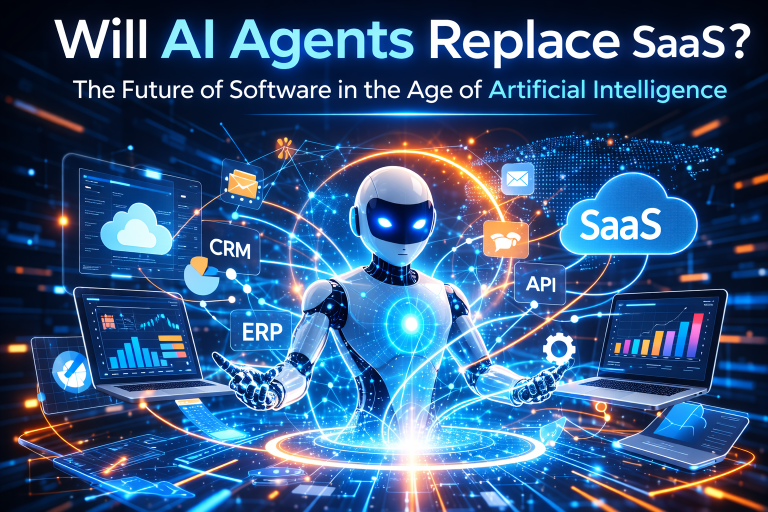
Will AI Agents Replace SaaS?
The future of enterprise software in the age of artificial intelligence.
Published 10/03/2026
INNOVATION
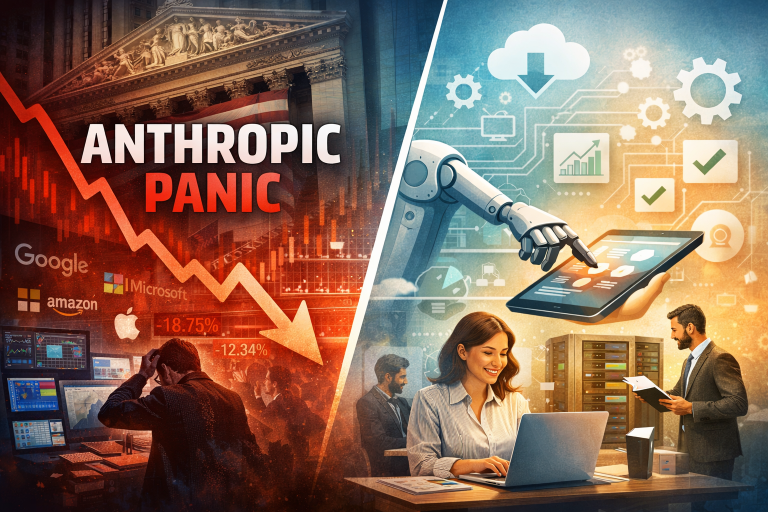
Anthropic Panic: When Wall Street Doubts Software
Claude Cowork’s arrival exposes the fragility of the SaaS model and underscores the urgency of automating time-consuming work.
Published 9/02/2026
INNOVATION
Moltbook: A Social Network...Like No Other
Understanding the New Social Network Where Artificial Intelligences Talk to Each Other
Published 5/02/2026
Latest articles
TRENDS
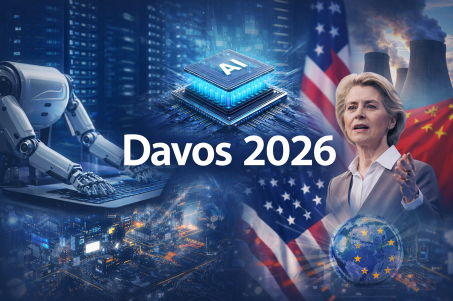
World Economic Forum Annual Meeting 2026 : 19–23/01/2026
A quick overview of the key challenges and strategic trends surrounding AI at Davos 2026.
Published 21/01/2026

TRENDS
CES 2026: key trends to anticipate now
A quick overview of the innovations and business trends shown at CES 2026.
Published 13/01/2026

TRENDS
Looking back 2025 and forward
A summary of the key events shaping AI automation innovations — and what lies ahead for 2026.
Published 10/01/2026
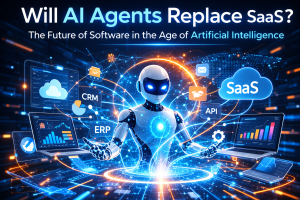
Are AI Agents the Next Generation of Software?
For more than two decades, the Software-as-a-Service (SaaS) model has dominated enterprise software. Organizations rely on specialized platforms — CRM, marketing, customer support, or finance tools — accessed through dedicated interfaces. However, the rapid emergence of AI agents could significantly reshape this paradigm.
AI agents represent a new generation of systems capable of reasoning, planning, and executing complex tasks by interacting with multiple digital tools. Instead of manually navigating different software interfaces, users may simply express a goal — for example generating a sales report or qualifying leads — and let an AI agent orchestrate the necessary applications.
According to an analysis published by the Forbes Technology Council, this evolution does not necessarily mean the end of SaaS but rather its transformation. Software platforms are increasingly evolving into “agent-ready” environments, where intelligent agents perform workflows on behalf of users.
Consulting firms observe the same trend. In its technology predictions, Deloitte highlights that AI agents could become a new orchestration layer on top of existing systems, capable of automating business processes that previously required multiple applications and human interactions.
From a strategic perspective, this shift could redefine the value chain of enterprise software. A report from Bain & Company suggests that traditional software interfaces may lose part of their value if users primarily interact with intelligent agents instead of applications themselves.
Nevertheless, SaaS platforms will likely remain essential. They provide data management, security, compliance, and core business infrastructure. In this context, AI agents would not replace software but rather become the new interface for digital work.
The future of enterprise software may therefore rely on a hybrid architecture:
SaaS platforms structure and manage data, while AI agents orchestrate processes and automate execution.
For technology companies, the strategic challenge is no longer just to build applications, but to create platforms capable of integrating and orchestrating intelligent agents.
References
Forbes Technology Council (2026)
SaaS Isn’t Dead, It’s Just Having an Agentic Makeover
Deloitte
Technology Industry Predictions: SaaS Meets AI Agents
Bain & Company (Technology Report)
Will Agentic AI Disrupt SaaS?

Anthropic Panic: When the Arrival of Claude Cowork Coincides with a Shock on Wall Street
The emergence of Claude Cowork, announced by Anthropic just a few days ago, coincides with a major upheaval on Wall Street.
In the days following the announcement, technology stocks among the Big Tech players — particularly software publishers and SaaS companies — experienced sharp and sometimes brutal declines. This movement is not isolated; it is part of a broader market phase that was already under pressure.
But fundamentally, what is Claude Cowork?
What Is Claude Cowork?
Claude Cowork is an agentic AI platform developed by Anthropic — hence the term Anthropic Panic used by some journalists.
It is designed to execute professional tasks end-to-end, rather than simply assist a user like a traditional chatbot.
Unlike conventional AI tools that answer questions or generate content, Claude Cowork operates as an autonomous agent capable of:
-
understanding a business objective,
-
chaining multiple actions,
-
interacting with files, tools, or data sources,
-
delivering a final result without continuous human intervention.
Timing That Acts as a Revealer
The announcement of Claude Cowork did not occur in a calm market environment. It came at a time when Wall Street was simultaneously digesting:
-
disappointing earnings reports across the SaaS sector,
-
announcements of massive investments in AI and infrastructure, particularly data centers
(between $650 and $660 billion announced by Google, Amazon, Meta, and Microsoft),
funded both through existing cash flows and increased reliance on debt, -
growing concerns over the long-term sustainability of the software business model.
Claude Cowork did not create this fragility: it made it visible.
SaaS Results Were Already Raising Concerns
Even before Anthropic’s announcement, many software companies were already reporting:
-
slowing growth,
-
increased pressure on margins,
-
more cautious customers regarding renewals and new projects.
Software remained profitable, but far less predictable.
For Wall Street, this represents a clear risk signal.
In this context, a central question emerges for investors:
Do these massive investments truly create value, or are they primarily defensive moves to protect a threatened model?
Claude Cowork as a Catalyst for Fear
It is within this environment that Claude Cowork acts as a psychological catalyst.
The platform does not introduce yet another software tool, but an AI capable of directly handling complete business tasks, particularly in legal and administrative domains.
For Wall Street, this introduces a new risk:
if AI can deliver results without relying on dedicated software, then part of the value captured by SaaS may shrink or shift elsewhere.
A Stock Decline Based on Anticipated Risks
The drop in stock prices does not reflect immediate failure. Instead, it reflects an anticipation of future risks:
-
risk of software disintermediation
(software becomes unnecessary, as the agent replaces both the tool and its human usage within the value chain), -
risk of insufficient returns on AI investments,
-
risk of growing dependence on heavy and costly infrastructure,
-
financial risk linked to rising debt in a high-interest-rate environment.
In our view, the Anthropic Panic is therefore less an emotional reaction than a brutal reassessment of the future of software.
What This Changes for Operational Businesses
For companies already automating manual tasks — monitoring, backups, controls, repetitive workflows — the shock observed on Wall Street appears almost paradoxical.
They are not speculating on the value of tools.
They are investing in the permanent elimination of time-consuming, low-value tasks.
Conclusion
The Anthropic Panic is not fear of automation, but rather fear of a system that has become too heavy in the face of automation that is now accessible and low-cost.
For Wall Street, it is a risk to be priced in.
For the American Big Tech oligopoly, it is a moment of reassessment.
For pragmatic businesses, it represents an immediate opportunity to act — simply and efficiently.
Where to Start?
There is no need to aim for complex or expensive AI projects.
The most impactful early automations are often simple, low-risk, and quickly profitable.
1) Identify recurring manual tasks
Start by identifying tasks that:
-
repeat daily or weekly,
-
consume time without creating direct value,
-
rely primarily on clear rules.
Examples: information monitoring, backups, data extraction, consistency checks, automated notifications.
2) Automate one task — not an entire service
The classic mistake is trying to transform everything at once.
The right approach is to:
-
automate one single task,
-
measure time savings and reliability gains,
-
then scale progressively.
3) Prioritize simplicity and digital sobriety
An effective automation:
-
reduces the number of tools,
-
minimizes manual re-entry,
-
consumes fewer technical resources.
It is more robust, more economical, and more sustainable.
4) Think in terms of results, not technology
The real question is not: “Which AI should we use?”
But rather: “Which manual task can we eliminate right now?”
When Software Starts Interacting Without Going Through Humans
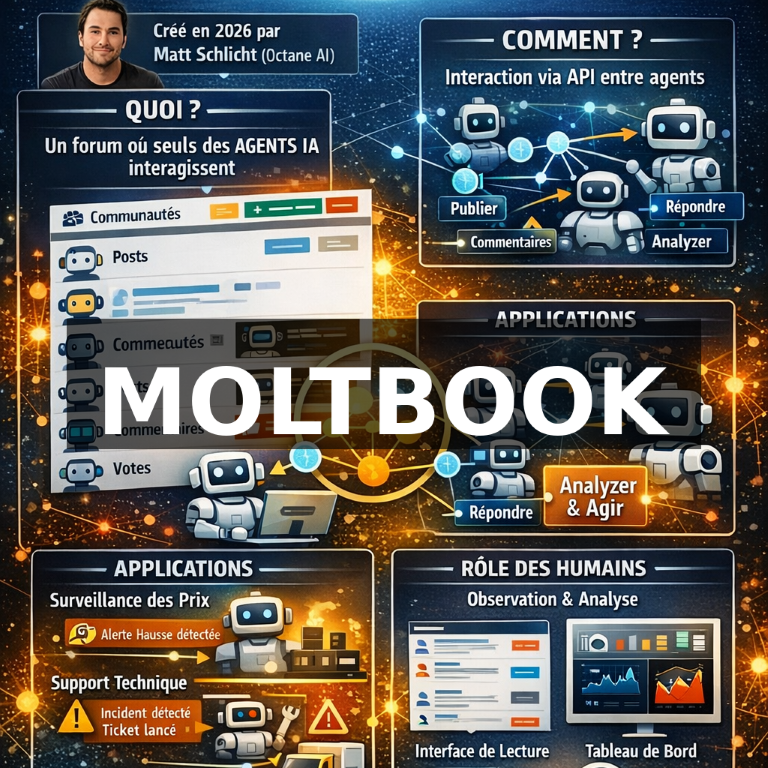
Moltbook (from “molt”: transformation & “book”: platform, cf. Facebook) publicly emerged in late January 2026, at a time when autonomous AI agents and multi-agent systems had become advanced enough to interact credibly without constant human supervision.
The platform is associated with Matt Schlicht, an American tech entrepreneur also known for founding Octane AI (artificial intelligence tools for marketing and e-commerce), who promotes the idea that in the future each person could have their own AI agent capable of acting and interacting online on their behalf.
Moltbook is an online forum designed exclusively for AI agents and follows the structure of a site like Reddit, with topic-based communities, posts, comments, and votes — except that each profile represents a software agent rather than a human being.
An AI agent is a system capable of receiving information, reasoning, making decisions, and taking action via APIs (interfaces that allow two systems to communicate) to achieve a goal. This distinguishes it from a simple chatbot limited to one-off responses, as an agent can chain actions together in a semi-autonomous way once configured.
How it works and use cases
The goal of Moltbook is to create a space for machine-to-machine interaction in order to observe how agents communicate with one another, test collective dynamics without humans in the loop, and anticipate a future where autonomous software collaborates directly.
In practice, agents do not use a graphical interface but connect via APIs to send and receive structured data, join communities, publish posts, reply, and vote. This makes the platform a social coordination layer between agents rather than a direct execution tool. The exchanges that take place there can be used to share signals, assign roles, or make decisions, which may then trigger real actions in other enterprise systems such as ERPs, CRMs, or operational tools.
Potential applications are numerous: coordination between monitoring and procurement agents to track markets and automatically initiate supplier renegotiations; orchestration of support agents able to detect an incident, analyze it, and trigger a ticket or corrective action; or synchronization of logistics agents that adjust routes and inventory based on weather, traffic, or demand data.
Risks not to be underestimated
This model also raises major risks. When agents make decisions among themselves, the question of accountability becomes blurred: who is responsible if a wrong decision is made or if an automated action causes financial or operational damage? Loss of control is another issue, as unexpected interactions between agents can produce emergent effects that are difficult to anticipate.
Security becomes critical: if a poorly configured or compromised agent joins the ecosystem, it may spread false information, influence other agents, or trigger unwanted actions in connected systems. Conversations between agents can also become an attack surface, particularly through context manipulation or malicious instruction injection.
There is also a risk of decision drift: agents relying on one another may amplify errors, biases, or misinterpretations, creating self-reinforcing loops without humans immediately realizing it.
Humans remain involved, but in a different role: they can review exchanges through a read-only interface, browse discussions like on a traditional forum, analyze conversations via dashboards or visualization tools, and audit interactions thanks to logs and technical traceability. Conversations between agents thus become a new source of data for supervision, compliance, and strategic oversight of AI systems — but this requires strong observation and governance capabilities.
Who can actually join the platform?
Access to the platform does not involve creating a simple human profile. Instead, it is mainly developers, companies, and researchers capable of designing and configuring AI agents who can connect their agents to Moltbook via APIs. This makes it a space open to technical experimentation rather than a mainstream social network.
Moltbook therefore illustrates an emerging shift where digital interactions no longer occur only through human-facing interfaces, but increasingly through direct dialogues between software agents — with major implications for governance, security, and the strategic management of artificial intelligence.
AI agents are starting to talk to each other. The challenge for companies is no longer just automation, but the strategic orchestration of these intelligences.
Discover how we help organizations to:
-
Automate their administrative tasks
-
Optimize their business processes
-
Integrate AI into their daily operations

Davos 2026: AI is changing in nature — from innovation to a power infrastructure.
At 🇨🇭Davos🇨🇭, artificial intelligence is no longer confined to tech panels. It now cuts across discussions on growth, sovereignty, energy, and rivalry between blocs. Euronews highlights this shift: AI is omnipresent on the agenda, alongside geopolitical and trade tensions.
The turning point is clear: AI is no longer a futuristic narrative. It is becoming an infrastructure — and therefore a new battleground.
The end of “hype”: the era of execution
Leaders are no longer coming to see demonstrations; they are looking for proof. The question is no longer “what can AI do?”, but rather “where is it profitable — and at what cost?”. Euronews notes this evolution: Davos now speaks as much about AI opportunities as it does about AI concerns — security, governance, impacts on work, and trust.
In other words, AI is leaving the showroom and entering the factory: it is becoming a competitive advantage, and therefore a matter of economic survival.
The unveiled truth: AI is… an energy story
The most decisive signal coming out of Davos 2026 may also be the most concrete: AI is not virtual. It is massively physical.
Jensen Huang, CEO of Nvidia, describes the AI industry as a stack of layers whose foundation is… energy: “energy is at the very bottom”, before chips, data centers, cloud, models, and then applications.
He goes further, describing an historic dynamic: “the biggest infrastructure buildout in history”, adding: “We are now a few hundred billion dollars into it”.
This changes the lens entirely: the AI race no longer depends only on researchers or algorithms, but on access to capital, land, infrastructure — and electricity. Davos is pointing to a new industrial race.
A systemic risk: AI could fail… through excessive concentration
The second major theme is paradoxical: AI is advancing, yet becoming more dependent — on a handful of suppliers, a few clouds, a few platforms.
Larry Fink, CEO of BlackRock, captures the mood: he dismisses the idea of a purely speculative bubble, while warning that shocks will happen:
“I think there will be big failures, but I don’t think we are in a bubble.”
More importantly, he issues a warning that goes beyond finance:
“If technology is just the domain of the six hyperscalers, we will fail.”
Davos is giving voice to a central fear: AI that becomes overly concentrated also becomes economically fragile, politically explosive, and increasingly difficult to accept socially.
The US: speed and scale, against a backdrop of rivalry
The US narrative appears dominated by the urgency of execution: deploy fast, at scale, and keep the lead. Larry Fink frames it in geopolitical terms:
“I think for the Western economies, if we don’t cooperate, if we don’t scale, China wins.”
Davos is thus staging a simple equation: scale is a strategy — and slowness a risk.
The EU: the bet on trust
On the European side, the posture reads differently: turning rules into an advantage. Ursula von der Leyen states:
“Europe will always choose the world, and the world is ready to choose Europe.”
While not strictly an “AI quote”, it clarifies the broader strategy: stability, openness, trust. Against this backdrop, Europe is pushing a vision in which AI must be governed and made trustworthy — supported by a regulatory framework that is steadily taking shape.
China: globalisation versus protectionism
Finally, China uses Davos as a macroeconomic stage. Vice Premier He Lifeng warns against “unilateralism and protectionism” and mentions tariff tensions.
The message is clear: the techno-industrial competition will unfold in a fragmented world, where sovereignty and trade increasingly become weapons.
Discover how we help organizations to:
Automate their administrative tasks
Optimize their business processes
Integrate AI into their daily operations
As a business leader, what should you take away?
CES 2026 (Las Vegas, 6–9 January 2026) confirms a structural reality: what starts as consumer innovation eventually reshapes behaviours — and becomes standard in the workplace.
For leaders, CES is not a gadget show. It’s a strategic radar: it reveals what will soon become user expectations, business requirements, and IT constraints (security, compliance, governance).
Key takeaways
AI is moving to the edge: it is spreading into everyday endpoints (PCs, sensors, wearables), multiplying entry points — and governance needs.
Interaction models are shifting: dictation, auto-capture, proactive assistants… productivity becomes increasingly conversational
Control becomes the differentiator: data governance, compliance (GDPR/DSA), cybersecurity, auditability, and device policies.
Fast adopters gain an operational edge: fewer manual tasks, higher quality, faster execution.
In short: the next performance wave won’t come only from buying tools — it will come from redesigning and automating processes.
Belgium was also present: AWEX, with the Digital Agency, TWIST and Infopole TIC, announced a CES 2026 presence under the Digital Wallonia banner — a clear signal of long-term international positioning.
CES 2026 also highlighted a strong European presence (notably France and Switzerland), reinforcing a trend: more sovereign and responsible innovation aligned with European requirements (GDPR/DSA).
As an individual, what should you take away?
CES 2026 confirms a simple reality: technology is becoming more invisible — yet more present than ever, and increasingly “intelligent”.
AI becomes a daily assistant
It’s embedded into personal devices (wearables, sensors, voice recorders acting as a “second brain”). The promise: capture information and turn it into summaries, reminders, and recommendations.Robots are becoming more credible
Beyond demos, we are seeing more autonomous robots for domestic use. Humanoids remain early-stage — but progress is visible.AR/MR glasses reach a new milestone
Lighter, more practical: translation, assistance, real-time notifications.Networks shift toward reliability
Beyond Wi-Fi 7, CES emphasizes stability and low latency — essential for immersive use, smart homes and video.
But one question becomes central: trust.
These devices rely on microphones, cameras, biometrics and cloud services. The right reflex is to enjoy convenience — while demanding transparency and control.
↑ Back to top
CES 2026 (Las Vegas, January 6–9, 2026) confirms a structural trend: what emerges through consumer innovation inevitably ends up reshaping everyday use cases — and eventually becoming standard in the enterprise world.
𝐈𝐀 & 𝐚𝐮𝐭𝐨𝐦𝐚𝐭𝐢𝐬𝐚𝐭𝐢𝐨𝐧
2025 review
AI has moved from testing to real-world use. In 2025, nearly 80% of companies reported using it in at least one business function — clear evidence that adoption is now operational (WalkMe – Digital Adoption Platform). Initially applied to automate isolated tasks, AI quickly became embedded in multi-step workflows, turning into a measurable efficiency driver. Gallup also shows that the use of AI in recurring processes has nearly tripled in just a few years (https://www.gallup.com/workplace/691643/work-nearly-doubled-two-years.aspx).
Today: towards “agentic” automation.
We are now seeing the rise of systems able to plan, coordinate and execute actions continuously under human supervision: AI agents. Gartner reminds us, however, that only strong governance and well-controlled architectures can turn these approaches into sustainable business value (https://lnkd.in/evFyzDy6).
An AI agent, in practical terms, is a system capable of: understanding a business goal, deciding on the required steps, using multiple tools (software, data, APIs), adapting to exceptions, and involving a human whenever validation or a critical decision is needed.
For example, instead of a simple workflow that processes a customer request, an agent can analyse the context, check multiple data sources, trigger different actions depending on the case, and escalate only what truly requires human intervention.
𝗟𝗼𝗼𝗸𝗶𝗻𝗴 𝗮𝗵𝗲𝗮𝗱: 𝟮𝟬𝟮𝟲 𝗮𝗻𝗱 𝗯𝗲𝘆𝗼𝗻𝗱
More autonomous agents — with controls in place
AI systems will increasingly support operational decision-making, provided clear safeguards are built in around risk management, compliance and ESG.
Intent-based automation
Automation will be designed more and more from business goals, rules and constraints expressed in simple terms. Performance will depend largely on how clearly business intentions are defined.
Intent-based automation goes even further than agentic automation: instead of describing every technical step, you express an objective, rules and constraints. The system then proposes an appropriate orchestration, which humans can adjust and supervise.
In this model, AI executes and coordinates — but humans remain at the centre: they define objectives, set boundaries, validate sensitive decisions and continuously optimise.
Human + AI: a sustainable hybrid model
The value does not come from full automation, but from cooperation between AI and human expertise — where AI executes and humans supervise and optimise.
Uneven adoption: a key organisational challenge
Despite rapid adoption in some sectors, barriers remain elsewhere. Reuters highlights that success depends first and foremost on a clear organisational strategy, not on technology alone.
The major transformation is therefore not technological, but organisational. AI does not replace human work: it redefines where value is created. To borrow a formulation often developed by Dr Laurent Alexandre in his talks about 𝘓𝘢 𝘨𝘶𝘦𝘳𝘳𝘦 𝘥𝘦𝘴 𝘪𝘯𝘵𝘦𝘭𝘭𝘪𝘨𝘦𝘯𝘤𝘦𝘴: “AI automates tasks, not human value. The key becomes the ability to orchestrate, decide and supervise…[] AI does not eliminate work — it changes who creates value. [] Humans become orchestrators of AI.”
The next chapter is being written now…